Classes teach Beekeeper best practices for raising honey bees that thrive!
Contact: • Tim Olson – For information on next Education Class – tim@nwiabka.org
Get on emailing list for upcoming beekeeping class schedule information held at Lakeside Lab
You do not need to be member to attend classes.

Editor’s Note: The ideas discussed and demonstrated during the Level 3 class have been practiced successfully by one or more of the three member teaching team members.
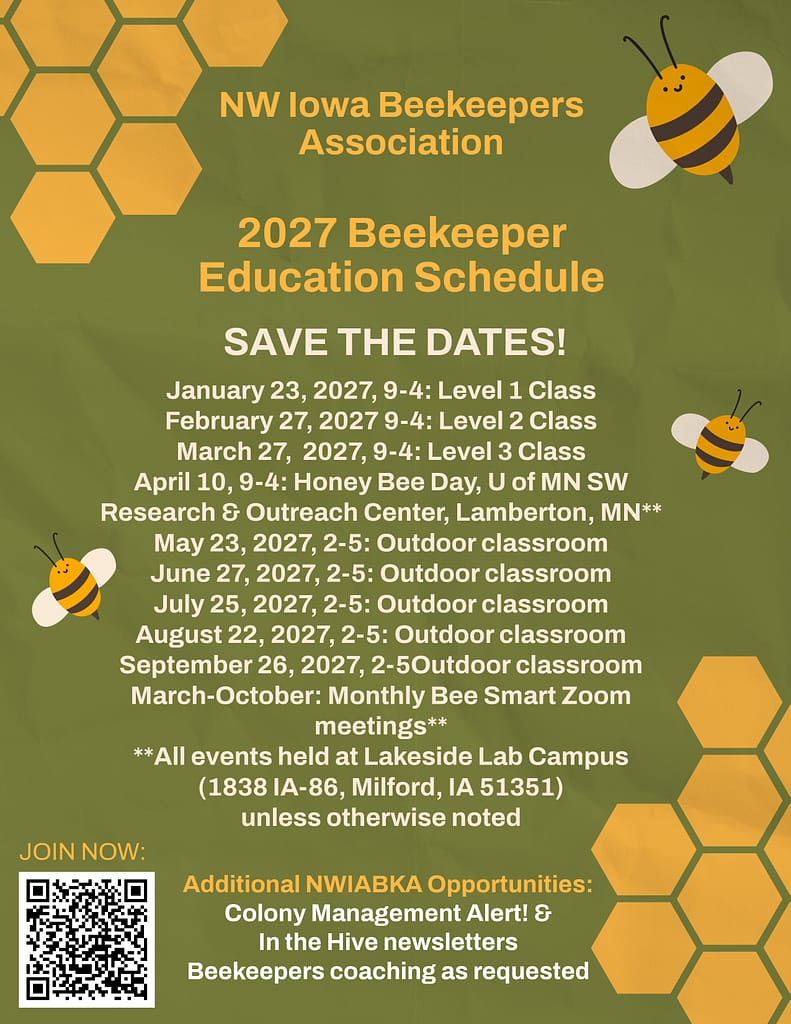
Level 3 Advanced Sustainable Beekeeping class is scheduled for Saturday, March 28 9 am.- 4 pm. at the Expo Building on the Dickinson County Fairgrounds, Spirit Lake, IA.
Level 3 Class – Next years spring class will be announced in a few months
- The multiple uses of double screens boards. The first attached picture shows the 8 frame and 10 frame Bob Binnie double screen boards that are the class door prizes.
- The Demaree is a vertical split to prevent swarms & increase honey production. It’s a great split for beekeepers wanting to limit colony numbers.
- The second attached photo shows a blending of a Demaree split and using a double screen board to increase hive numbers. The photo shows the four honey supers harvested and the two 8 frame splits harvested. There is one queen excluder between the bottom brood box and the honey supers and another between the honey supers and the second top brood box. There is a Bob Binnie double screen board between the second and first brood boxes. The top box double screen opening faces opposite that of the second brood box. The bottom brood box and the two top brood boxes were queened with swarm cells. Two to three swarm cells were placed in each brood box. Each box produced a virgin queen that returned successfully from a mating flight.
- The next three photos show the two top brood boxes harvested from the Demaree split and placed in a different bee yard. Please note that the Bob Binnie double screen board was used as the bottom board. The pictures also demonstrate the use of a modified condensing hive model for overwintering.
- The last picture is the picture of a typical Demaree split to prevent swarming and for enhanced honey product. This colony had successfully overwintered its fourth winter. Beginning its fifth year this colony has been designated to provide a potential breeder queen.
- The techniques for managing summer splits of four and five frame colonies for overwintering success. Understanding hive thermal dynamics.
- The nurturing of five and five frame overwintered nucs to become “brood factories.”
- The selection of breeder queens. Testing for hygienic gene traits.
- The pros and cons of a single brood box management to maximize honey production.
- The options for maximizing honey production using two-queen colony systems.
- The feeding of overwintered colonies to minimize swarming and to have colonies at peak populations just prior to the major nectar flow.
- The new options for Varroa mite control, including Narroa.
- Q &A
Class students will receive:
The NWIABKA Board will provide great food for lunch and refreshments. Thank you!!!
The U of MN “Guide to Beekeeping in Northern Climates”
Several colony management hand-outs
White colored queen marking pen
The chance to win one of the Bob Binnie double screen boards
The next Bee Smart Zoom meeting will discuss: NW IA Beekeepers Association
Bee Smart Zoom Meeting Schedule
Join to get link to zoom meeting
• The importance of selecting adaptive bee stock as part of an Integrated Pest Management (IPM) strategy • Identifying the characteristics of available bee stock • Suggested credible bee stock providers • Possible questions to ask a bee stock provider • Review of the NWIABKA commitment to help beekeepers raise healthy bees that thrive • Q & A
NWIABKA Annual Member Meeting
Sunday, April 26, 2-5 p.m.
Topic: Beekeeping & Speaker TBD. Last year was “Today Podcast”, Dr. Becky Masterman
Upcoming Bee Smart Zoom meetings:
April 16 – “Why did my bees die?” – What is learned from diagnosing overwintered colony deaths.
Level 3, & 4 Classes, 8:30 a.m. registration at the Expo Building, Dickinson County Fairgrounds, Spirit Lake, IA.
Level 3 Class in March
Level 3 – Saturday, March 28 – Advanced techniques for mastering beekeeping. Skills: Small scale raising of local queens: selecting and culling breeder colonies, managing for successful mating of virgin queens, managing five frame and double nucs as “brood factories”, using the Demaree (and modified Demaree) split for swarm control, quality control for selling nucs and queens, IPM and biosecurity advanced practices, and more.
Level 4 – Fall, 2026 – Mentor Training – Coaching the best practices of sustainable beekeeping with novice beekeepers.
January – April 2026, 7:30 pm. Bee Smart Zoom Meeting Schedule:
For the upcoming Zoom meetings:. Contact Tim for latest link. laughingeyes2010@gmail.com
- February 19 -:”Buying good bees that thrive” – Being a wise consumer when buying bee packages, nucs, and queens
- March 19 – “Kickstarting overwintered colonies for spring” – Preparing colonies to thrive in the spring
- April 16 – “Why did my bees die?” – What is learned from diagnosing overwintered colony deaths.
NWIABKA Annual Meeting – Sunday, April 26, 2 pm.
- Final Steps for Winterizing Colonies
- Winter Varroa treatment options
- Emergency feeding of colonies
- New Varroa control treatment – Norroa
- 2026 beekeeping goals – What are your goals for the next year?
- 2026 NWIABKA goals – increase the presence of VSH bee stock in NWIABKA colonies, identify local winter hardy VSH colonies, local winter hardy VSH queen and mini nuc production, continuation of the five frame nuc project, and offering Level 1,2 & 3 classes.
- Q & A – What are you thinking?
Demonstration of techniques for preparing colonies for winter survival including – late season re-queening, merging colonies, and feeding strategies.
Sunday, June 22, 2025, 2-4:30 pm
Queen Bee Rearing Class
Location: Dickinson County (ISU) Extension and Outreach Office, 1600 15th Street, Spirit Lake, IA

Class Instructor Phil Breed: VP of Siouxland Beekeepers
The Principles & Practices of On the Spot (OTS) Queen Rearing
Whether you manage one hive or several, a key component is viable queen accessibility. Even better are queens from your own local stock. Shortly after July 4th is an ideal time of year for the 43rd parallel in the Northern Hemisphere (that us!) to raise late summer queens for overwintering. Learn Mel Disselkoen’s technique of OTS (On the Spot) queen rearing.This will be a hands-on (bee free) active demonstration on the basics of OTS with options incorporating techniques from G. Demaree and L.E. Snelgrove. No grafting tools or experience needed. Minimal disruption to our colonies. Increased probabilities of winter survival and maintaining the numbers of colonies desired.”
Management on the Spot (MOS): Queen Bee Rearing
- Managing supercedure cells – please refer to the attachment: “Help! I need a queen” by Dr. Meghan Milbrath
- Managing Varroa mites – please refer to the attachment: “Resources for Integrated Pest Management (IPM) and Varroa Mite Control” by Cornell University
- Managing Varroa mites – please refer to the attachment: “Tools for Varroa Management” by Honey Bee Health Coalition (HBHC), website link: honey bee health coalition.org.
- Managing Varroa mites – please refer to the attachment – “Methods to Control Varroa Mites: An Integrated Pest Management Approach” by Penn State Extension
- A Varroa mite sampling and treatment record sheet will be available at the meeting.
- Drone Varroa trap foundation will be available at $4/frame – please pay by check or exact cash
- Pro-formic and Apiguard treatments will be available for sale – watch for a posting of costs per treatment on Friday
- Q & A from your bee yards
Happy Beekeeping!!
Annual Outdoor Classroom.
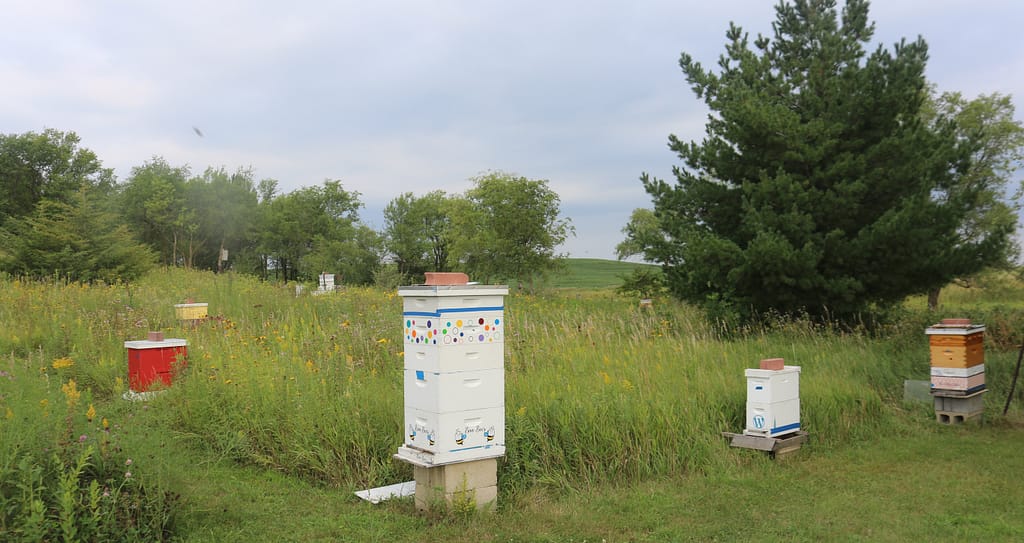
Sunday, June 1, 2025 2-4:30 pm – 2026 date TBD?
Location: Steve Lende Apiary, 2102 120th St., Spirit Lake, IA * Diamond Lake Honey & Bees
Raising Healthy Bees That Thrive is not only the tagline of the NWIABKA, it is the #1 priority for beekeepers. Raising healthy bees that thrive results in colonies that live through the winter, reproduce surplus bee stock, maximize honey production, and provide the best opportunity for positive financial return on investment. Striving to raise healthy bees that thrive is about ethical beekeeping that benefits the individual beekeeper, the beekeeping community, and most importantly – the bees! Managing healthy bees should include a plan to protect colonies from pests and diseases. The 2025 Outdoor Classroom introduces several protective management ideas for raising healthy bees that thrive. Please join us for a buzzing good time learning about honey bees.
Bee Smart Zoom Meeting scheduled one Thursday month. Become member, attend ZOOM BEE education.
The May 1st Bee Smart Zoom meeting will discuss challenging and/or changing the rules of beekeeping norms that may improve winter survival of our beloved honey bee colonies. This week’s April 21st AgWeek magazine’s cover story is “Staggering Losses:more than half of the nation’s honeybee colonies died over the winter”. I’m aware that there are NWIABKA members who likewise experienced devastating winter colony losses this past winter. For too many years I was discouraged by high rates of winter colony die outs.Three years ago I decided either I change my beekeeping management to improve overwintering success or get out of the beekeeping business. I’ve been challenging and/or changing the rules of beekeeping norms that I was taught and have been teaching. The results have been 80% winter survival rate in 2024 and 100% overwintering survival of 15 colonies this past winter. The colonies overwintered in triple, double, and single 8 frame hives, five over five nuc boxes, and double nucs with boxes full of bees. Please note this is only one year of 100% overwintering success. I’ll need a couple more winters to test the ideas to know if the 2025 winterwintering success is a fluke or can be replicated. I’ll share what I’m learning about colony genetics, feeding protocols, swarm control, disease and mite prevention. There will also be time for all NWIABKA members to share beekeeping blessings, challenges, and lessons being learned in our bee yards. Beekeeping is a community project!!
Level 1 class Zoom meetings. All meetings are scheduled for the second Thursday of the month, April – October, at 7:30 p.m. A reminder with the Zoom meeting link will be sent to you the Tuesday before each scheduled Thursday Zoom meeting. Please post the following dates on your calendar.
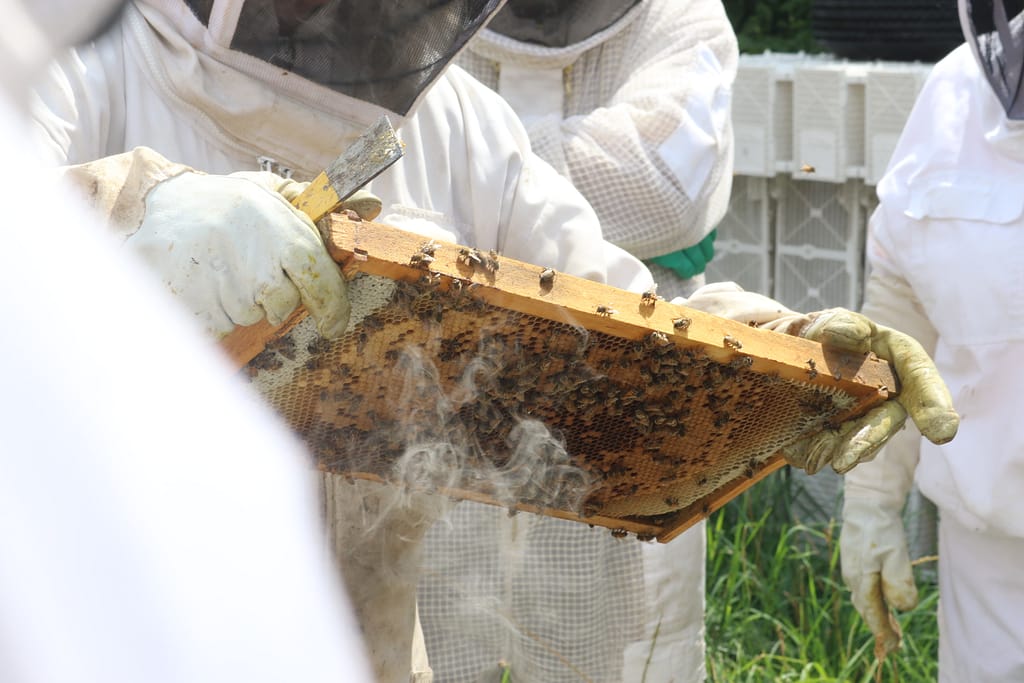
Honey beekeeper booth at Clay County Fair, Spencer Iowa. September 12-20 2026
August 24th, 2025 Sunday 2-4:30 pm – Association Meeting – NWIABKA members.
NWIABKA Board member Jean Irwin will demonstrate how she adds value to her beekeeping business by rendering wax and creating saleable products.
Options for managing high moisture honey – (robbing & Varroa control if delaying the removal of honey supers)
Support of Fellow Beekeeper – Jim Kraninger
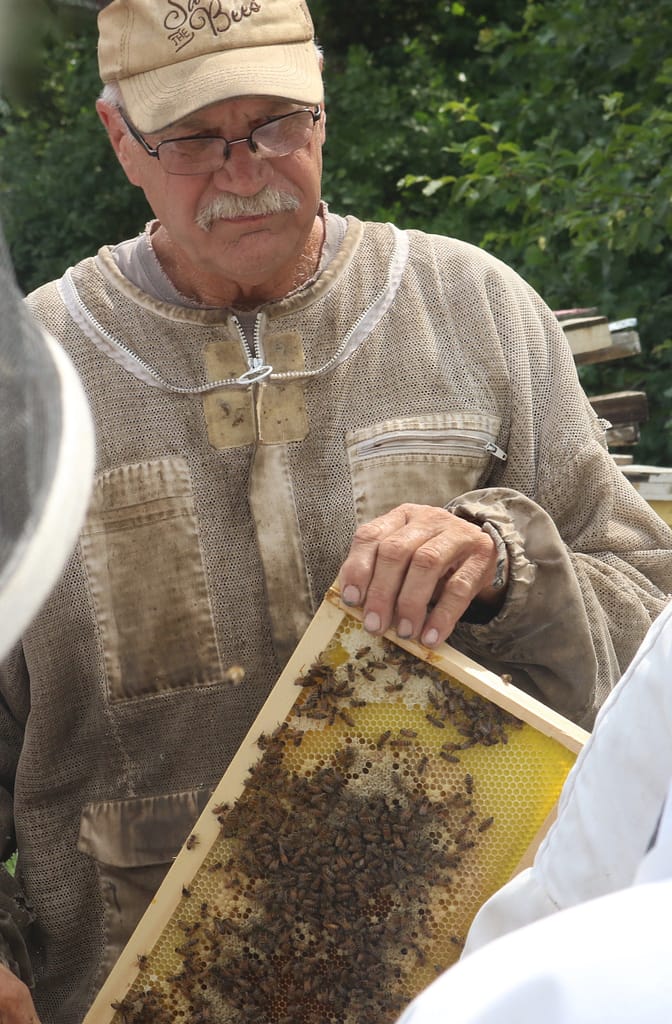
Longtime NWIABKA member, Jim Kraninger of Milford has been hospitalized by a life-changing health challenge. For several years Jim offered his family’s beautiful homestead for hosting Association meetings. Please consider donating to support Jim.

Discussion: winter death loss post-mortem; early spring hive inspection; spring feeding strategy; minimizing swarming without making a split; capturing and managing a swarm colony; comb rotation; encouraging the coating of hive boxes with a propolis envelope; queen replacement; and Q&A.
- April 27 – Association Meeting
- May 9
- June 1
- July 10
- August 14
- September 11
- October 9
The “hands-on” basic beekeeper skills in the bee yard Outdoor Classroom is set for Sunday, June 1, 2-4:30 p.m. Location TBA.
You’re invited and encouraged to attend the NWIABKA Annual Meeting on Sunday, April 26, 2 p.m. at the Dickinson County Extension office building. During the meeting you’ll receive a certificate of completion for attending the Level 1 class. It’ll be a great opportunity to meet members of the Association and talk bees!
As members of the Association you’ll receive the newsletter, In the Hive. The newsletter will include beekeeping and event information.